
Goldenbet License and Australian Legal Status
 Available in AU
Goldenbet is an online casino and sportsbook operated by Santeda International B.V. Its official domain is goldenbet.com, and the domain appears on a licence record maintained by the Curaçao Gaming Authority. That certificate answers a question about the operator’s authorisation in Curaçao. The separate question for Australians is whether online casino services can lawfully be supplied to people physically in Australia. Australian rules decide that question, irrespective of a licence issued overseas.
Two public records are especially relevant: the Australian Communications and Media Authority’s formal warning concerning the Golden Bet service, and the Curaçao regulator’s certificate naming Goldenbet.com. Reading them together gives a clearer picture of the brand’s identity, the territorial limits of its licence and the practical path for a payment or account complaint. The Australian sports bookmaker GoldBet, associated with goldbet.com.au, is a different business and its permissions do not attach to Goldenbet.
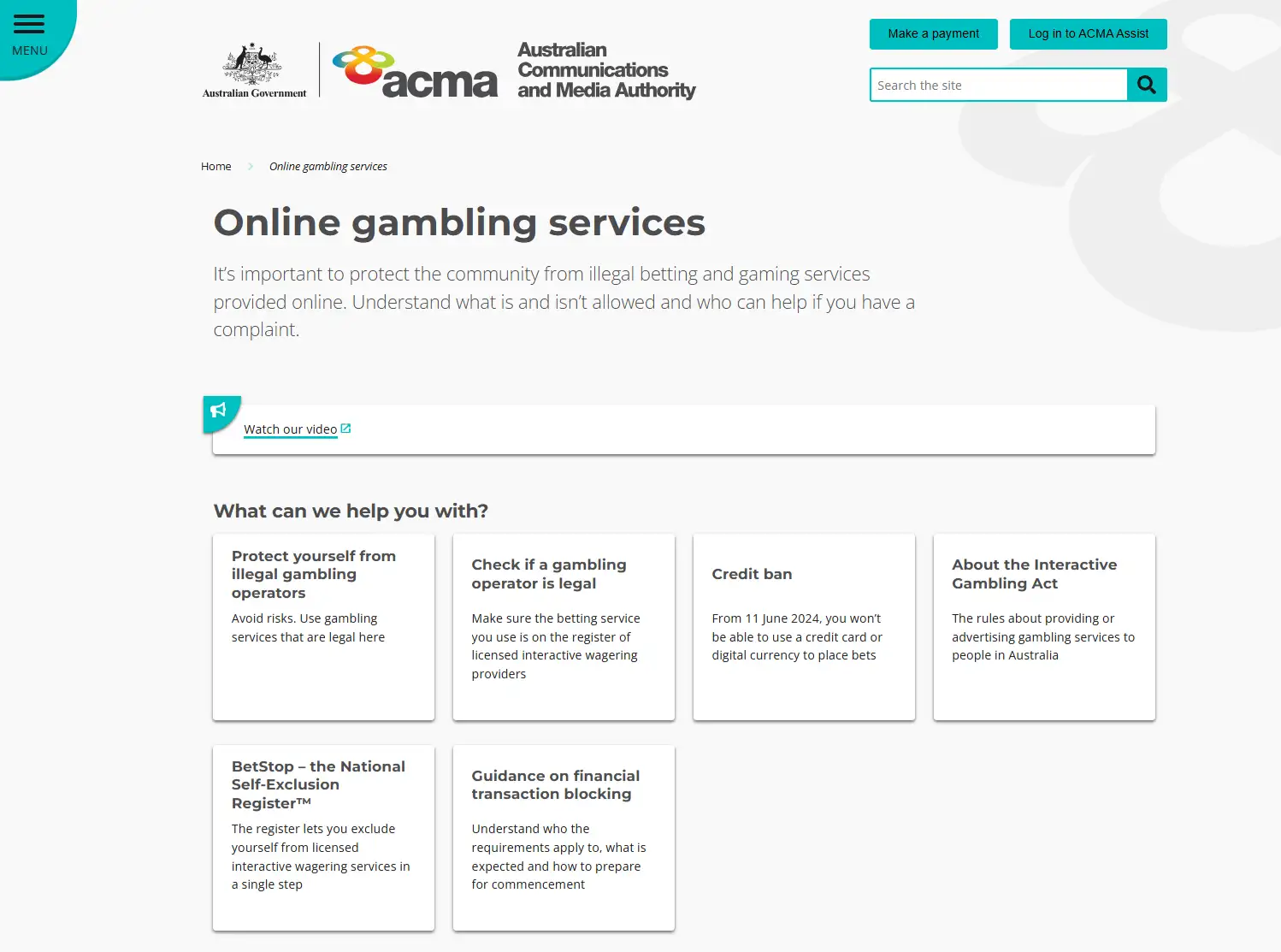
Table of Contents
- Why online casino play is prohibited in Australia
- Australian tax treatment is separate from casino legality
- What ACMA's formal warning establishes about Golden Bet
- Where different complaints belong
- What the Curaçao licence covers
- Why the regulatory boundary matters in a dispute
- Questions about Goldenbet's licence and Australian rules
- What the two jurisdictions mean for consumer recourse
Why online casino play is prohibited in Australia
Australia’s Interactive Gambling Act 2001 prohibits the supply of specified interactive gambling services to customers physically present in Australia. Online casino services fall within that prohibition, including electronic slot machines and casino-style table games offered over the internet. For Goldenbet’s casino product, an overseas casino certificate does not create an exception. The question is the location of the customer and the nature of the service being offered, not whether a webpage displays Australian dollars or allows an Australian country selection.
The rule is directed at supplying prohibited services. It should not be confused with a general statement that every form of online wagering is unlawful in Australia, or with a conclusion about the criminal liability of an individual customer. Certain licensed sports and race wagering services are a separate regulatory category. They operate under applicable Australian state or territory licensing and federal restrictions. A casino site’s sportsbook tab, however, does not turn its online slots or live-dealer roulette into permissible domestic casino offerings.
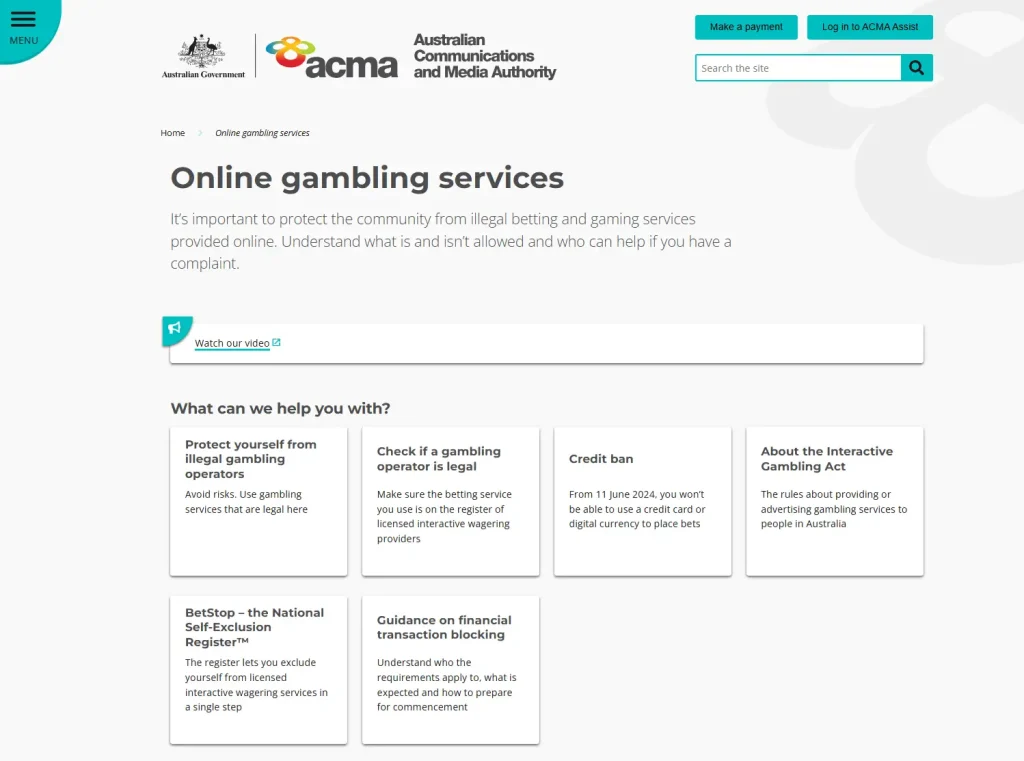
The Australian Communications and Media Authority, usually called ACMA, is the national regulator responsible for enforcing the federal interactive-gambling requirements. Its interactive gambling guidance at acma.gov.au/interactivegambling distinguishes prohibited online casino services from wagering products that may be supplied under the relevant conditions. It also explains how Australians can report suspected unlawful services. A lawful Australian sportsbook licence must be connected to the specific licensed operator and service; it cannot be borrowed from an unrelated brand with a similar name.
The appearance of AUD in Goldenbet’s general account-currency list changes none of this. A currency option is a feature of a global payment system. It is neither a territorial licence nor permission to serve Australian residents. Likewise, a third-party casino directory can describe payment methods or a gaming library without deciding Australian legality. For the separate mechanics of that catalogue, the Goldenbet payment methods section distinguishes platform-wide options from the Australian legal position.
Australian tax treatment is separate from casino legality
Australian tax rules address the treatment of receipts and transactions. Gambling legislation addresses whether a service may be supplied. These are different legal questions. A general tax treatment of a recreational gambling win cannot make the underlying offer lawful, and a foreign operator’s casino licence cannot determine an Australian person’s tax obligations.
For individuals who gamble recreationally, ordinary gambling and lottery winnings are generally not assessable income under Australian Taxation Office guidance. The circumstances matter: an activity amounting to a business, or receipts connected with other income-producing conduct, may raise different questions. The ATO’s guidance on amounts not included as income is a starting point for this general distinction, rather than a ruling on a particular person’s transactions.
Goldenbet is a hybrid platform with both fiat and cryptocurrency payment options in its global catalogue. Crypto adds another possible tax event. Acquiring, transferring, converting or disposing of a crypto asset can have consequences that are distinct from the treatment of a gambling win itself. In practical terms, the value of an asset on receipt, its cost base and a later disposal may matter even where the gambling receipt is ordinarily treated differently for tax purposes.
Keep the two records separate: the gambling transaction and any subsequent digital-asset transaction. Useful records may include the currency or asset involved, dates, transaction hashes where applicable and the value applied for any conversion. These are general recordkeeping considerations, not a conclusion about tax payable. Anyone facing a real tax-reporting question should obtain advice from a qualified Australian tax professional familiar with gambling and crypto assets.
What ACMA’s formal warning establishes about Golden Bet
ACMA began investigating the Golden Bet service in September 2023. In a formal warning dated 4 December 2023, the authority named Santeda International B.V. and the Golden Bet service. The document considered the service’s links to customers physically in Australia and identified contraventions of the Interactive Gambling Act 2001, including sections 15(2A) and 15AA(3).
That warning is specific to the Golden Bet service and the entity behind goldenbet.com. It should not be confused with licensing or commercial records for GoldBet Pty Ltd, the separate Australian bookmaker. Similar names do not establish common ownership, an interchangeable gambling licence or a shared complaints process.
ACMA’s finding described prohibited and unlicensed services offered to Australian customers. The warning also recorded the absence of an applicable Australian state or territory wagering licence for the relevant regulated service at the time of the investigation. The document is therefore more specific than an abstract explanation of the federal law: it addresses this operator’s conduct and the Australian customer connection examined by the regulator.
A formal warning has a particular legal character. It is a formal regulatory enforcement action; it is not the same as a court judgment, damages award or promise that an individual affected customer will obtain reimbursement. Nor should its December 2023 date be presented as evidence of a new court finding in a later year. The warning’s value is that it identifies the operator, the service, the statutory provisions and the conduct that ACMA assessed at that time.
The ACMA formal warning to Santeda International B.V. is the underlying regulatory document (acma.gov.au, formal warning to Santeda International B.V.). It is more useful than a generic casino review when evaluating what the authority actually said. It also separates the historical enforcement record from the later Curaçao licence record, which concerns a different regulator and a different legal question.
Where different complaints belong
The first distinction in a complaint is between a suspected breach of Australian gambling law and a private dispute with the operator. ACMA receives reports about prohibited interactive gambling services. It enforces the relevant statutory framework; it is not a casino cashier, an account-support department or an Australian licensing authority for Goldenbet’s Curaçao casino.
A report to ACMA can identify the service and why the person believes it may have been supplied in breach of the Australian rules. Factual particulars help: the brand and domain involved, dates, the type of game or service and any relevant correspondence. The regulator determines its own enforcement response. Sending a report does not itself initiate a bank refund, order an account payout or guarantee a personal financial remedy.
For a private balance or withdrawal dispute, the operator’s account terms and communications are directly relevant. Goldenbet provides customer support, including live chat, and its general terms describe complaint handling. The terms call for complaints within two months of an incident; that is an operator-set contractual window, not a deadline imposed by ACMA. A person with an existing dispute may need to preserve the date of the issue, a complete conversation history and copies of any decision received from the operator.
It helps to organise the material by the question it answers:
- Identify the service. Keep the exact domain and brand name, avoiding confusion with the unrelated Australian GoldBet bookmaker.
- Identify the transaction or decision. Record the relevant date, amount, method, reference number and any account-verification request.
- Keep the correspondence. Retain support transcripts, email responses, notices of account restrictions and the operator’s written reasons where supplied.
- Choose the appropriate channel. A suspected prohibited offering can be reported to ACMA; an account or payment dispute is first a matter for the operator and any applicable independent dispute process.
These paths can coexist without being substitutes for each other. A regulator might investigate an unlawful service while an individual remains in a separate disagreement over funds. Conversely, resolving a private payment dispute says nothing about whether the service could legally be supplied in Australia. The relevant facts for each channel are different, so a concise, chronological record is usually more useful than a broad allegation lacking transaction details.
What the Curaçao licence covers
The Curaçao Gaming Authority’s certificate names Santeda International B.V. and includes Goldenbet.com among the domains associated with the operator’s licence. The identifier is OGL/2024/1798/1048, issued on 14 August 2024. The authority’s certificate displays an application status of Granted and a licence status of Active. Those labels describe the Curaçao registry entry; they are not Australian licensing classifications.
This is a domain-specific check. A regulator may license an operator with several brands, and a list of related domains does not mean those brands share a single consumer identity, game catalogue or set of payment terms. The meaningful question for Goldenbet is whether the exact Goldenbet.com domain appears within the certificate. It does. That association is more precise than inferring legitimacy from a licence badge in an unrelated review or a similarly named website.
| Registry field | Goldenbet entry | Reader implication |
|---|---|---|
| Regulatory authority | Curaçao Gaming Authority | The certificate is issued within Curaçao’s gambling framework. |
| Operator | Santeda International B.V. | Identifies the corporate licensee behind the service. |
| Licence identifier | OGL/2024/1798/1048 | Distinguishes this licence record from other operators’ entries. |
| Issue date | 14 August 2024 | Dates the displayed Curaçao authorisation. |
| Listed domain | Goldenbet.com | Connects the registered licence to the relevant website. |
| Registry status | Granted / Active | Describes the entry in the issuing jurisdiction, not Australian permission. |
The official Curaçao Gaming Authority licence entry allows a reader to check the licence identifier and listed domain together. A certificate or register entry should be read as a statement of its issuing authority’s scope. It does not replace the country-specific law governing supply of a casino service elsewhere.
A useful way to interpret licensing information is to separate three questions: who holds the licence, which domain it covers, and where the licensed activity may be offered to customers. The first two are answered by the Curaçao register for Goldenbet. The third depends on the laws of the country in which the service is supplied, including Australia’s prohibition on online casino supply. Conflating those questions is how a technically accurate foreign certificate can leave a misleading impression about local availability.
Why the regulatory boundary matters in a dispute
Consumer protection becomes more complicated when the operator’s certificate and the customer’s jurisdiction do not align. Goldenbet’s licence is within Curaçao’s framework, while Australia prohibits supplying online casino services to people in Australia. Australian regulatory enforcement of that prohibition does not convert the casino into an Australian-licensed product or make ACMA the decision-maker for every private account balance.
For someone reviewing a past transaction or an unresolved claim, the practical questions concern evidence and the relevant counterparty. The name Santeda International B.V. connects the brand to the licensee. The precise domain goldenbet.com distinguishes the casino from similarly named businesses. The operator’s terms help identify the account and payment requirements the company applies. A chronological record of requests and responses helps separate a verification delay from a claimed forfeiture or disputed settlement.
Those questions become clearer when treated separately:
- Lawfulness of supply: the Australian interactive-gambling rules and ACMA’s enforcement remit.
- Issuer and licensee: the Curaçao certificate covering Santeda International B.V. and Goldenbet.com.
- Account obligations: the identity-verification, payment ownership and complaint provisions in the operator’s terms.
- Transaction evidence: amounts, methods, dates and communications relevant to a disputed payment or balance.
For example, a request for identity documents is governed by account-verification rules and can affect when a withdrawal is processed. That question is distinct from whether the online casino could lawfully serve the Australian customer in the first place. The withdrawal rules describe the platform’s general €20 equivalent minimum, rolling caps and verification considerations. Those figures should be read as operator-wide terms rather than evidence of an Australian casino entitlement.
The overall picture is specific rather than interchangeable: a Curaçao licence record with a named domain, an Australian statute that prohibits the online casino service, and a historical formal warning to the same operator. Each record answers a different question. Keeping them distinct makes an account problem easier to describe, reduces confusion with unrelated brands and avoids treating a foreign licence as Australian consumer protection.
Questions about Goldenbet’s licence and Australian rules
Does Goldenbet’s Curaçao licence authorise online casino play in Australia?
No. Australia prohibits supplying online casino services to people physically in the country. Goldenbet’s Curaçao licence does not authorise that supply.
Was Golden Bet named in an ACMA formal warning?
Yes. ACMA issued a formal warning to Santeda International B.V. concerning the Golden Bet service on 4 December 2023 after investigating its Australian customer connection and prohibited or unlicensed interactive gambling services.
What licence number is associated with Goldenbet.com?
The Curaçao Gaming Authority certificate identifies licence OGL/2024/1798/1048, issued on 14 August 2024, with Goldenbet.com among its listed domains.
Where can a suspected prohibited online gambling service be reported?
ACMA receives reports of suspected prohibited interactive gambling services in Australia. It is a regulatory reporting channel, not a guarantee of reimbursement for an individual account dispute.
What the two jurisdictions mean for consumer recourse
Goldenbet.com’s Curaçao licence identifies Santeda International B.V. and a registered domain under certificate OGL/2024/1798/1048. Australia’s Interactive Gambling Act separately prohibits the online casino offering to customers physically in the country, and ACMA has a specific formal warning concerning the Golden Bet service. The certificate, the Australian enforcement record and the operator’s account terms have different functions: identity and foreign authorisation, local statutory compliance, and private transaction rules. None substitutes for the others when assessing a complaint or the scope of consumer protection.